Type rate my photo into a search engine and you get a strange mix of results: dating-profile graders, phone apps that put a number on your camera roll, wedding-culling software, research papers about aesthetic models. That's not because the web is confused. It's because the phrase hides three very different questions, and every tool worth considering was built to answer one of them — and usually only one.
We make one of these tools — Photoreka Picks, an AI photo ranker for photographers — so read this as an informed comparison, not a neutral one. We've tried to be straight about where each alternative is the better choice, and we've only included what we could check on each product's own pages at the time of writing (November 2026).
Three Questions Hiding Behind 'Rate My Photo'
- How do I come across in this picture? This is the dating-profile, LinkedIn and social-media question. What's being judged is the person — trustworthy, confident, attractive — far more than the photograph.
- Is this a technically good photo? Sharp, well exposed, decently composed, eyes open. This is the camera-roll and client-delivery question, and it's the one AI answers most reliably.
- Which of these hundreds of frames are my best ones? This is the photographer's question: picking a portfolio, a contest entry, the twenty pictures worth showing from a trip. It's about storytelling, originality and intent, and it's the hardest to automate.
Use a tool built for the first question on the third, and you get a confident number that means nothing. Use a culling tool on a street photography archive, and it will happily reject your best frame because it's soft. So before comparing tools, it's worth knowing which question you're actually asking.
Photofeeler: How You Come Across, Rated by People
If your question is the first one, the most honest answer isn't an AI at all. Photofeeler shows your photo to real people, who score it on traits relevant to the context you choose: dating, business (think LinkedIn) or social profiles. You can earn a free test by voting on other people's photos, or buy credits for faster results.
Its strength is exactly that it doesn't pretend: how a face reads to strangers is a human judgment, and asking humans is the most direct way to measure it. Some of the AI graders that rank for the same searches describe themselves, in their own terms of use, as entertainment. Who it's for: anyone choosing a profile picture. What it isn't: a way to judge photography. A beautifully composed street photograph and a well-lit headshot are answering different questions — and so is Picks, which judges photographs, not the people in them.
rate-my-photo.com: A Free Score for a Single Photo
rate-my-photo.com is the simplest tool on this list: take or upload one photo and an AI model returns a score from 1 to 10 for its overall aesthetic quality. The site says the model was trained on more than 20,000 images annotated with human aesthetic scores, and it looks at the whole frame rather than just the face — a bad background can pull the score down. It's free, with no signup and no account, and photos are processed in memory rather than stored unless you choose to share a result.
Who it's for: curiosity, or a quick sanity check on one picture. Limits: it works one photo at a time and gives you a single overall number, so it won't sort a shoot, and it can't tell you why one frame beats another.
On Your iPhone: Better Camera and SpectraSort
Two iPhone apps turn the same idea into a camera-roll tool. Compare Photos: Better Camera (listed as 'Ranker: Pick Best Photos') gives each selected photo an AI aesthetic score from 0 to 10 and sorts them so the strongest rise to the top; its built-in camera even shows a live score while you frame. It's free to download, with optional subscriptions — $0.99 a week or $9.99 a year at the time of writing — for full access and more processing.
SpectraSort runs entirely on the phone, with no account and nothing uploaded. It surfaces your sharpest, best-exposed, best-composed shots, removes duplicates, lets you search for a subject in plain words, and learns your taste as you use it. Sorting is free and unlimited; a paid Premium tier lifts the weekly limit on actions like sharing or deleting and adds finer quality controls.
Who they're for: cleaning up a phone library and finding the keeper among ten near-identical shots. Limits: they're built around the photos on your iPhone (both also list compatibility with Apple-silicon Macs), and their scores lean on technical and general aesthetic quality rather than the criteria an editor or a contest jury would use.
General Chatbots: ChatGPT, Gemini and Claude
Plenty of people now simply upload a photo to a general AI assistant and ask for a rating. For a single image, this works better than you might expect: modern chatbots write articulate critiques, notice composition and light, and can respond to a brief ('is this strong enough for a documentary portfolio?').
The problems appear when you need a ranking. Ask twice and the number moves. Ask about photo 3 and photo 300 in different conversations and there's no guarantee they were judged on the same scale. And a chat window is built for a conversation, not for working through a folder of several hundred files. Who they're for: a second opinion on a handful of images. Limits: consistency and scale.
AI Culling Tools: Aftershoot, Narrative Select and Co.
If you shoot weddings, events or portrait sessions, the 'AI to choose best photos' you want is probably a culling tool. Aftershoot covers culling, editing, retouching and delivery in one desktop app for Windows and macOS that works offline, so files never leave your machine; it offers 30 days of full access without a credit card. Narrative Select is another established option, with paid plans starting at $15 a month (or $10 a month billed yearly) at the time of writing, a free trial and no permanently free plan. FilterPixel and Imagen also offer AI culling.
These tools are excellent at their job, which is turning thousands of client frames into a deliverable set: grouping near-duplicates, flagging blur and closed eyes, keeping the best of each moment. Who they're for: working professionals with high-volume shoots and a client waiting. Limits: they're priced and designed for that workflow, and a deliverable set is not the same thing as an artistic ranking. The motion-blurred street frame with all the energy in it is precisely what a technical cull is built to throw away.
Photoreka Picks: Ranking Your Own Work Like a Jury Would
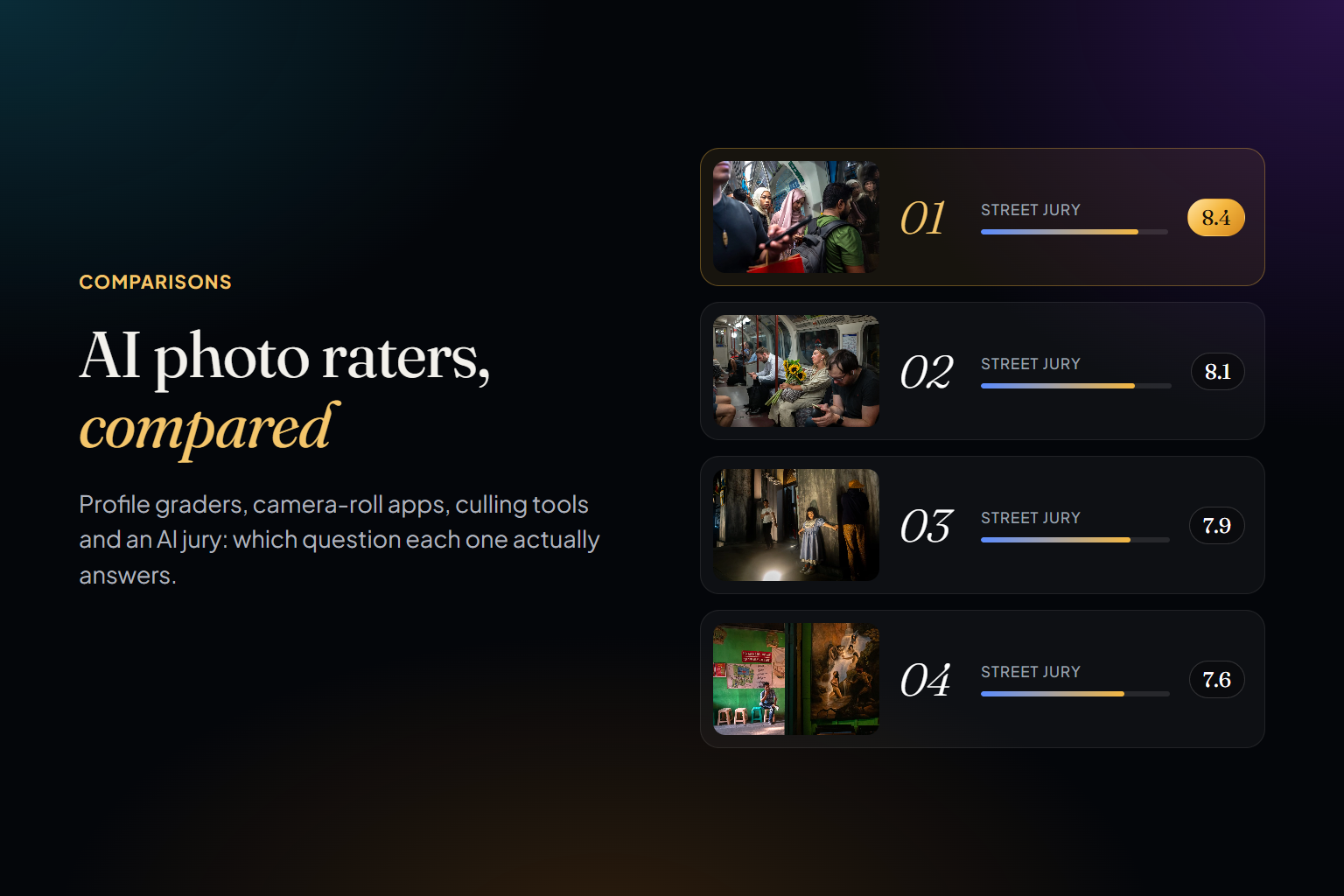
Picks exists for the third question. You drop up to 5,000 photos — a whole trip, a year of street work, the shortlist for a contest — and an AI jury scores every frame from 1 to 10 on eight artistic criteria: aesthetics, composition, storytelling, originality, message, humor, visual games and spontaneity. Each photo also gets a one- or two-sentence critique naming what makes it work or what holds it back, the way an editor would say it in a portfolio review. A real example, for a street photograph in our demo set:
The split frame between the smoking man and the sensuous waterfall painting is a clever visual rhyme; a slight step left to avoid cutting the right figure's arm would refine it further.
Picks jury
Then you rank. The Overall jury weighs aesthetics, composition, storytelling and originality; street, documentary, landscape, portrait, travel and fine art juries weigh them their own way and only rank the photos of their genre; award juries keep only the photos above a high bar. Identical copies are grouped and judged once, so duplicates don't crowd your top picks, and you can export the whole ranking as CSV.
The practical details: no account and no subscription; €0.013 per photo, VAT included, paid once per order with a €2.90 minimum — so 500 photos cost €6.50 and 5,000 cost €65. Only an 800-pixel thumbnail of each photo is sent for judging; your full-resolution files stay on your device. A private link to your ranking reaches your inbox, and thumbnails and results are deleted after 30 days and never used to train AI models. You can try it free with 10 of your own photos, critiques included, with no card and no account.
Limits, honestly: Picks doesn't judge faces or profile pictures, and it isn't a client-delivery culling tool. It accepts JPEG, PNG and WebP, so RAW files need exporting first. The jury doesn't know a contest's theme or rules, so the final call against a brief is yours. And it's built for one-off batches: if you want scores kept on your body of work permanently, that's Photoreka's Photo Scoring, part of a full account.
How AI Rating Actually Works — and Where It Breaks
Almost every AI photo rater learned the same way: a model is shown large numbers of images alongside scores people gave them, and it learns to predict the score a new image would get. That's useful, and it has a built-in ceiling. The model learns what the average annotator liked, which tends to be pleasant, sharp, bright and conventional. Ask it to rate a deliberately unsettling documentary frame and it will often prefer a sunset.
The deeper issue is that a score is an opinion, not a measurement. A street photographer and a landscape editor would never pick the same frame from the same folder, and neither would be wrong. Collapsing everything into one global number hides that disagreement instead of showing it to you.
Whatever you use, treat the ranking as a shortlist, not a verdict. The AI's job is to get you from 2,000 frames to 50 worth looking at closely. Choosing the final 12 — and the order they're seen in — is still editing, and editing is yours. We wrote more about that last step in how to pick your best photos from hundreds of shots, about how to sequence the final set, and about why culling is not editing.
Which One Should You Use?
- Choose Photofeeler if: you're picking a dating, LinkedIn or social profile picture and want to know how real people read it.
- Choose rate-my-photo.com if: you want a free, instant score on a single photo and nothing more.
- Choose Better Camera or SpectraSort if: the photos live on your iPhone and you want the camera roll sorted by quality, with duplicates out of the way.
- Choose a general chatbot if: you want a written second opinion on two or three images and don't need them ranked on a consistent scale.
- Choose Aftershoot, Narrative Select or another culling tool if: you shoot weddings, events or sessions for clients and need a deliverable set fast.
- Choose Photoreka Picks if: you're a photographer choosing your own best work — a portfolio, a contest entry, the best of a trip or a year — and want artistic criteria, a critique for every frame and more than one jury's point of view.
Try it on your own photos
Let the Picks jury rank your best photos
Eight artistic criteria, a critique for every frame and juries for street, documentary, landscape and more. Free with 10 photos, no account.
One last thought. The reason 'rate my photo' returns such a mess of results is that people rarely want a rating for its own sake. They want to make a decision: which picture goes on the profile, which frames go to the client, which twelve go into the portfolio or the competition. Pick the tool built for your decision, and the number starts to mean something. If that decision is a contest, our guide to choosing which photos to enter in a photography contest is a good next read.