Most photographers spend weeks on a contest entry and about ten minutes choosing it. They open the folder, scroll until something feels right, and send the photo they remember best. The result is predictable: most entries don't lose because they are bad photos, they lose because they were the wrong photos to send. A strong frame in the wrong category, a beautiful image the jury has seen five hundred times, a picture that only works at full screen when the first round is judged on a grid of thumbnails.
Choosing well is a separate skill from shooting well, and it can be learned. This is the process we recommend, from reading the brief to sending the file.
Read the Brief Before You Open Your Archive
The brief decides what a winning photo looks like before any judge does. Read it twice and write down, in your own words, what each category is really asking for. A “street” category that also accepts staged portraits is a different contest from one that requires candid moments. A theme such as “resilience” will be read literally by some juries and metaphorically by others; past winners are the best evidence of which one you are facing.
- Category definitions: what belongs, and what is explicitly excluded.
- Editing rules: many documentary and nature competitions forbid adding or removing elements, and some ask for the original raw file if you reach the final round.
- Rules on AI-generated or AI-edited images, which are now common and strictly enforced.
- Number of entries, whether a series is allowed, and whether entries can be previously published or awarded.
- Technical specs: file size, long edge, colour space, and naming conventions.
Build a Long List Fast, Without Filtering by Memory
Your memory of a shoot is a poor index of your archive. You remember the photos that were hard to take, the trips that mattered, and the frames people praised, and none of those is the same as your strongest image. So start wide: pull every photo that could plausibly fit the brief into one folder, even the ones you are unsure about. For most photographers that means a long list of 30 to 100 candidates, sometimes drawn from several thousand frames.
This is the step where most people give up and fall back on the three photos they always send. If your archive is large, it is also where a tool helps most: an AI photo picker can rank thousands of frames in minutes and surface strong images you had forgotten, so your long list is built from the whole archive rather than from what you happen to remember. We cover the general workflow in how to pick your best photos from hundreds of shots.
Pass the First-Glance Test
Large competitions receive thousands of entries, and the first round is usually a fast screening on a screen, often on a grid of small images. A judge may spend only a few seconds on each photo before deciding whether it moves on. Your photo has to earn a second look before it can win on its subtleties.
Test it the same way. Put your long list on a grid at thumbnail size, step back, and note which images still read: a clear subject, a strong shape, a striking light or colour, a gesture you understand instantly. Photos whose power depends on a small detail, a caption, or knowing the story behind them tend to fall at this stage, however good they are at full size.
Judge the Frame, Not the Memory
The hardest bias to escape is the back-story. You know how cold it was, how long you waited, how rare the moment felt. The jury knows none of that; they only see the rectangle. For each candidate, ask one question: if a stranger had taken this, would I still put it on the shortlist? If the answer depends on something outside the frame, the photo is probably weaker than it feels.
Score Each Candidate Against What Juries Reward
Every competition words it differently, but most juries weigh a similar set of qualities. Scoring your shortlist on them, even roughly from 1 to 10, forces you to compare photos on the same terms instead of on mood:
- Impact: does the photo stop you, and does it hold you after the first second?
- Composition: is every element in the frame working, with clean edges and a clear reading order?
- Storytelling and message: does the image say something, or only show something?
- Originality: has the jury seen this subject, from this angle, many times this year?
- Moment and spontaneity: in street and documentary work especially, is it a decisive moment or a well-lit scene?
- Technical execution: focus where it matters, controlled highlights, an edit that serves the image rather than announcing itself.
Then weigh those scores for the category. A street jury will forgive some noise for a perfect gesture; a landscape jury will not forgive blown highlights for a nice composition. The same photo can be a finalist in one category and an early cut in another, which is why it is worth checking where each candidate is strongest before deciding where to enter it.
Ask for a Critique, Not a Vote
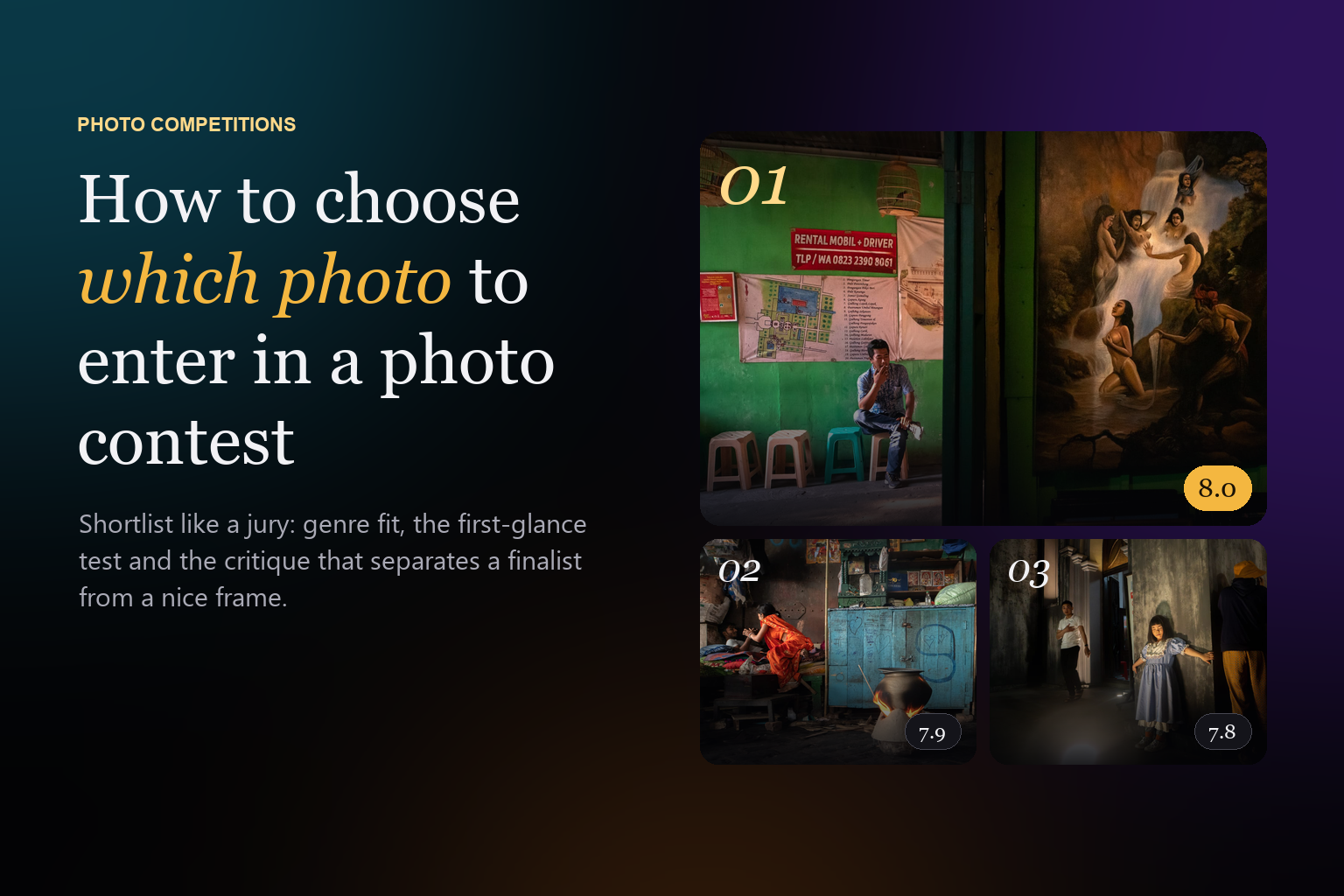
Asking friends “which one do you like?” gives you a popularity vote, and popularity rewards bright colours, cute subjects and familiar views. What you need is a reason: what makes the frame work, and what holds it back. A critique such as “the split frame creates a clever visual rhyme, but the right edge cuts the figure's arm” tells you both whether to send the photo and how to improve it before you do. Ask a photographer you trust, a club, or a mentor, and ask them to explain their ranking.
Singles vs Series
If the contest accepts series, judge the set as a whole. A series is only as strong as its weakest image, and juries notice repetition fast: two photos that make the same point weaken each other. Look for consistency of tone and treatment, a sequence that builds, and a final image that closes the story. When in doubt, a tight series of five beats a loose series of ten.
Final Technical Checks
- View the final file at 100% and look for sensor dust, halos from sharpening, and banding in skies.
- Check the edit against the rules: no added or removed elements if the category forbids it.
- Export to the exact specs, in the requested colour space, and keep the original raw file ready.
- Write the title and caption carefully; in documentary categories they are part of the entry.
- Re-read the deadline and the time zone.
Where AI Fits in the Selection
AI will not choose your entry for you, and it shouldn't: it does not know the theme, the jury, or what you are trying to say. Where it is genuinely useful is in the two slowest steps: going through the whole archive to build the long list, and giving you a consistent second opinion on each candidate. Photoreka Picks does exactly that: you drop up to 5,000 photos, an AI jury scores every frame on eight artistic criteria and writes a short critique for each one, and you can rank the results through genre juries such as street or documentary, or through award juries that only keep photos above a high bar.
Build your shortlist
Let an AI jury pre-select your contest entries
Try Picks free with 10 of your own photos: scores, a written critique for each frame and every jury. No account, no card.
Whatever tools you use, the principle is the same: read the brief, search the whole archive, test at a glance, and choose with reasons rather than memories. The photo that wins is often not the one you love most; it is the one that makes a stranger stop.