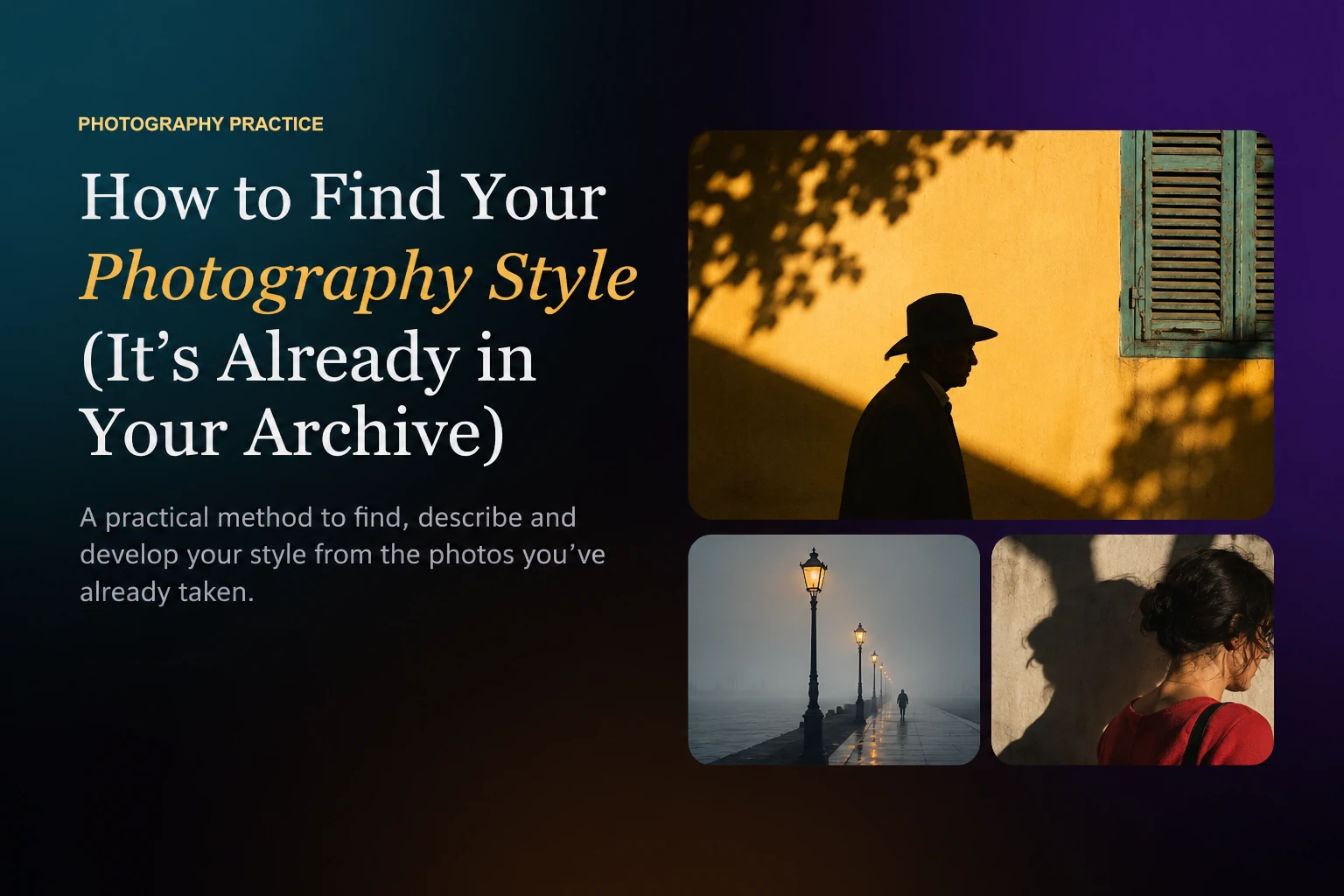
Style is what people recognise in your photos before they read your name. Most advice on finding it comes down to one instruction: look back at your work and notice what you keep doing. It's good advice, but it assumes you can actually see your work. With a few hundred photos you can. With twenty thousand spread across folders, drives and years, you see your last shoot and a handful of favourites, and the pattern stays invisible. Your style already exists; the hard part is seeing it.
Style Is What You Repeat, Not What You Admire
There are two lists in every photographer's head. One is the work you admire: the photographers you follow, the books on your shelf. The other is the work you actually make. Style lives in the second list. It is the sum of the decisions you take without thinking — where you stand, when you press the shutter, what you leave out of the frame — repeated across hundreds of photos.
That is why style is found rather than chosen. Your influences tell you where you'd like to go; your archive tells you where you are. The two rarely match, and the gap between them is useful information, not a failure.
The Five Layers of a Style
“Style” is too vague to analyse in one go. Break it into layers and look at each one separately:
- Subject: what you point the camera at — people, streets, landscapes, details — and, just as telling, what you never photograph.
- Light: hard or soft, golden hour or midday, backlight, night, flash.
- Colour and tone: your palette, warm or cold, saturated or muted, colour or black and white, high or low contrast.
- Composition: how close you stand, how much empty space you leave, symmetry or tension, a centred subject or one pushed to the edge, a single layer or several.
- Moment and mood: the decisive instant or stillness; humour, melancholy, tension, intimacy.
Editing sits on top of all five, but it is the thinnest layer. A preset can give a set of photos a common look; it can't give them a common way of seeing. If your photos only look alike after the preset, the style is in the preset, not in you.
Step 1: Audit What You Actually Shoot
Start from the photos you kept over the last two or three years, not from everything on the card: rejects are noise. Pick thirty to fifty favourites by instinct, without thinking too hard, and lay them out together — a grid in your catalog, a contact sheet, prints on a table. Then go layer by layer and write down what dominates.
Count instead of judging. “Twelve of forty are backlit” or “almost nothing is shot closer than three metres” is far more useful than “I like moody light”. Numbers expose habits you would never describe on your own.
Step 2: Look Across Years, Not Across One Shoot
A single trip always has a look, because the place imposes it. Style is what survives a change of place and subject: the same distance, the same light, the same palette in Lisbon and in your own neighbourhood. Compare shoots from different years and different genres, and keep only what appears in all of them.
Do the same across time. Put a year from your early work next to the last twelve months. What did you drop? What appeared and stayed? Style is not fixed, and seeing its direction is often more useful than seeing where it stands today.
Step 3: Put Your Style into Words
Sooner or later you need a sentence: for a bio, an artist statement, a portfolio introduction, a client brief or a contest entry. A simple structure works: subject + light or colour + composition + mood. For example:
- “Quiet urban scenes in soft, low light, framed from a distance with plenty of empty space.”
- “Close, warm, candid portraits of people at work, in available light.”
- “Graphic black-and-white street photography built on hard shadows and layered frames.”
Avoid a genre label on its own (“I'm a street photographer”) and adjectives that describe everyone (“authentic”, “unique”, “timeless”). The test for a good description: could a stranger pick your photos out of a pile using only your sentence?
Step 4: Develop It on Purpose
- Edit tighter. Style becomes visible when you stop showing the photos that don't belong.
- Shoot a project with a constraint: one lens, one neighbourhood, one season. Constraints force you to repeat decisions, and repetition is what a style is made of.
- Build series, not single images. A series reveals consistency, or the lack of it, faster than anything else.
- Look at the gaps. What you never shoot is information too. Try it on purpose once and see whether it belongs.
- Repeat the audit every year and compare the two descriptions.
For the first and third points, our guides on how to pick your best photos and how to sequence photos cover the method step by step.
Common Traps
- Confusing a preset with a style.
- Copying a photographer you admire instead of finding what you genuinely share with them.
- Forcing consistency too early: style needs volume before it shows.
- Judging only from your latest shoot, which reflects the place more than you.
Seeing a Whole Archive at Once
The audit above works with fifty photos. It breaks with twenty thousand, which is exactly where a long-term style shows. This is where software can help — not by telling you what your style should be, but by showing what you already do across everything you kept.
Photoreka analyses every photo you keep — subject, light, colour, composition and mood, plus eight artistic scores — and gives you several ways to look at the result.
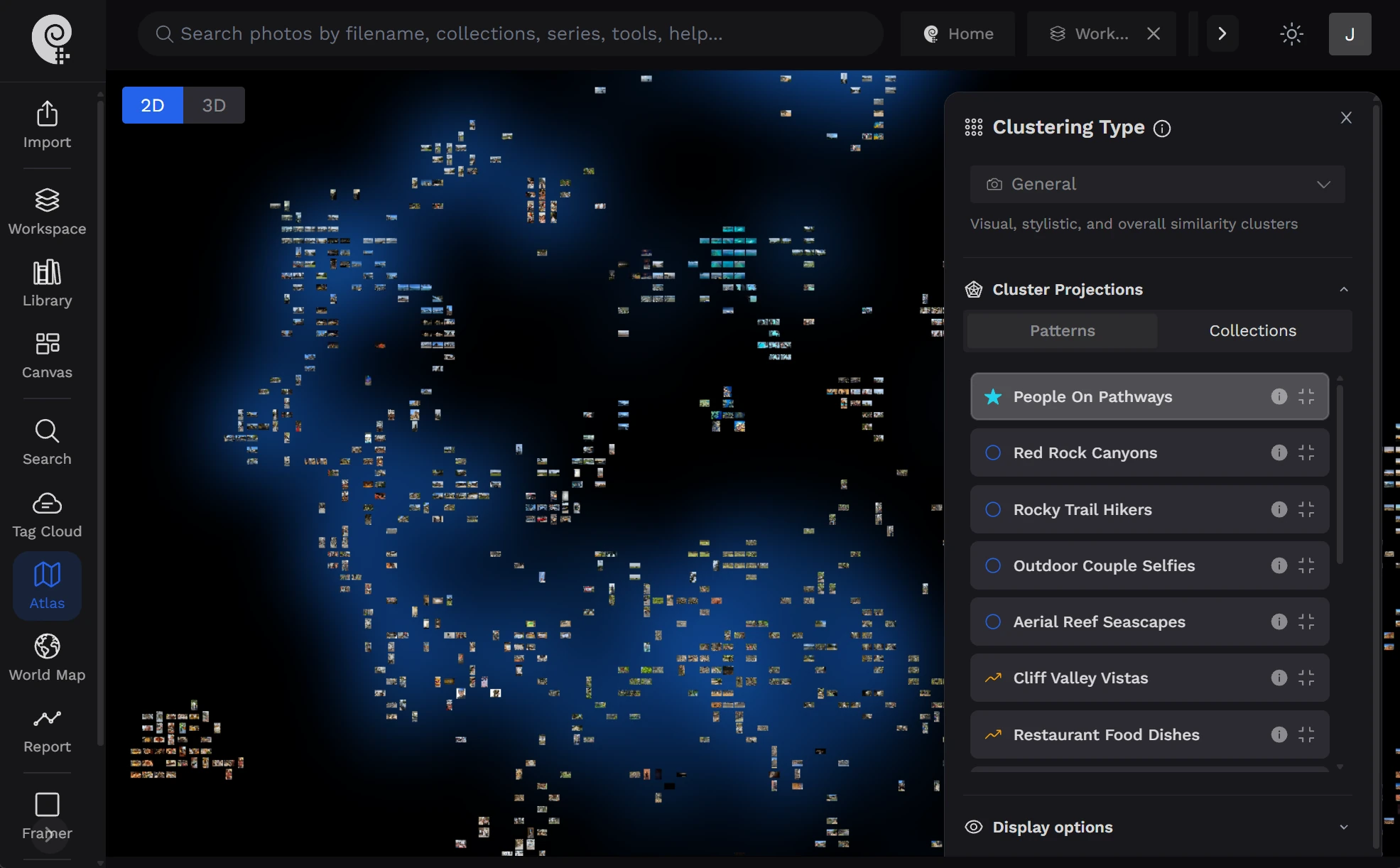
The 2D/3D Atlas places your whole catalog on one map, grouped by what the images actually look like: the dense regions are the work you keep returning to, and the empty space is the work you haven't made yet.
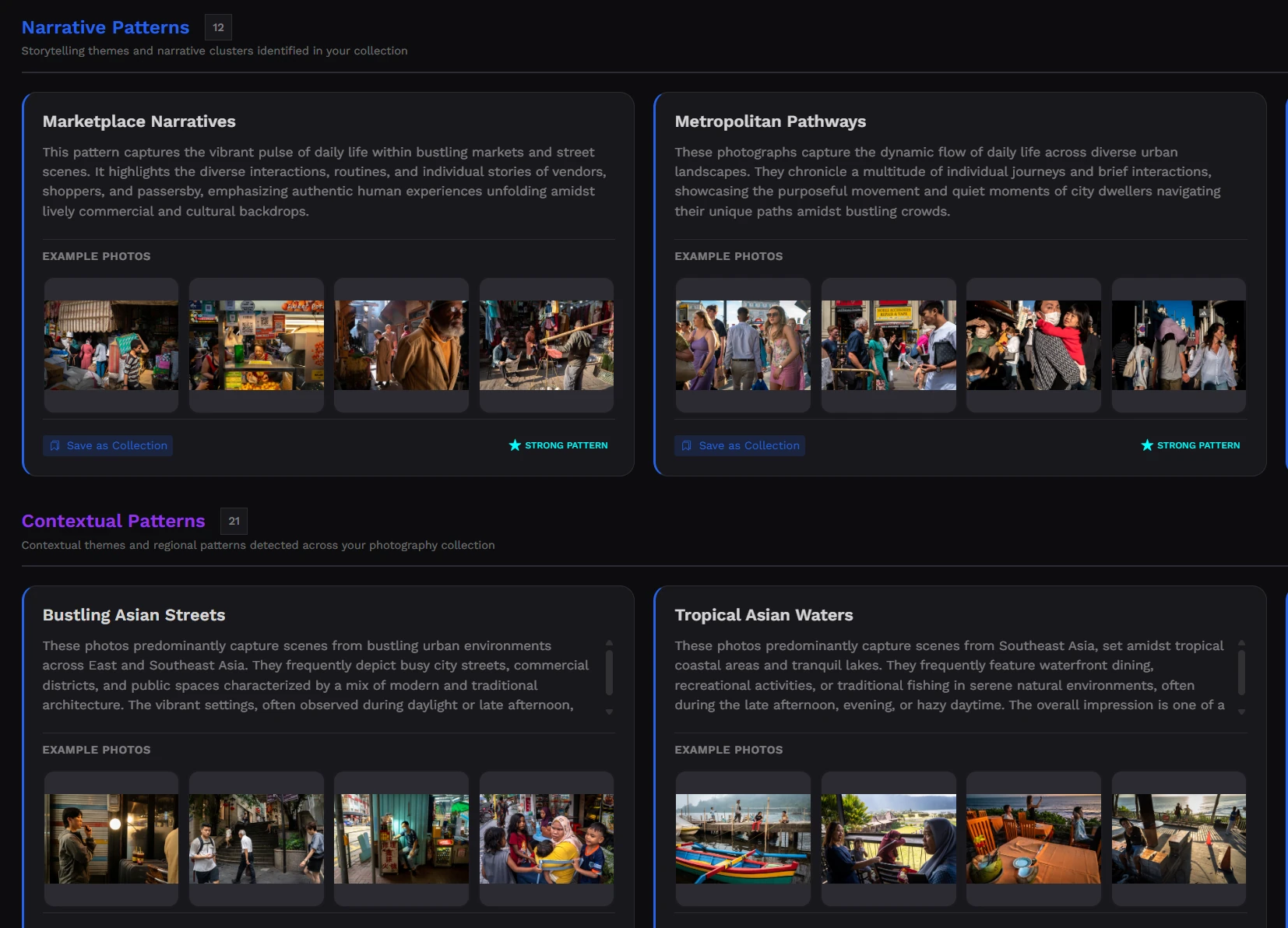
Reports summarise your dominant colour profiles, moods and recurring motifs, your strengths and gaps across the scoring criteria, and how your scores evolved month by month. They also name the narrative and contextual patterns that run through your work, each with example photos.
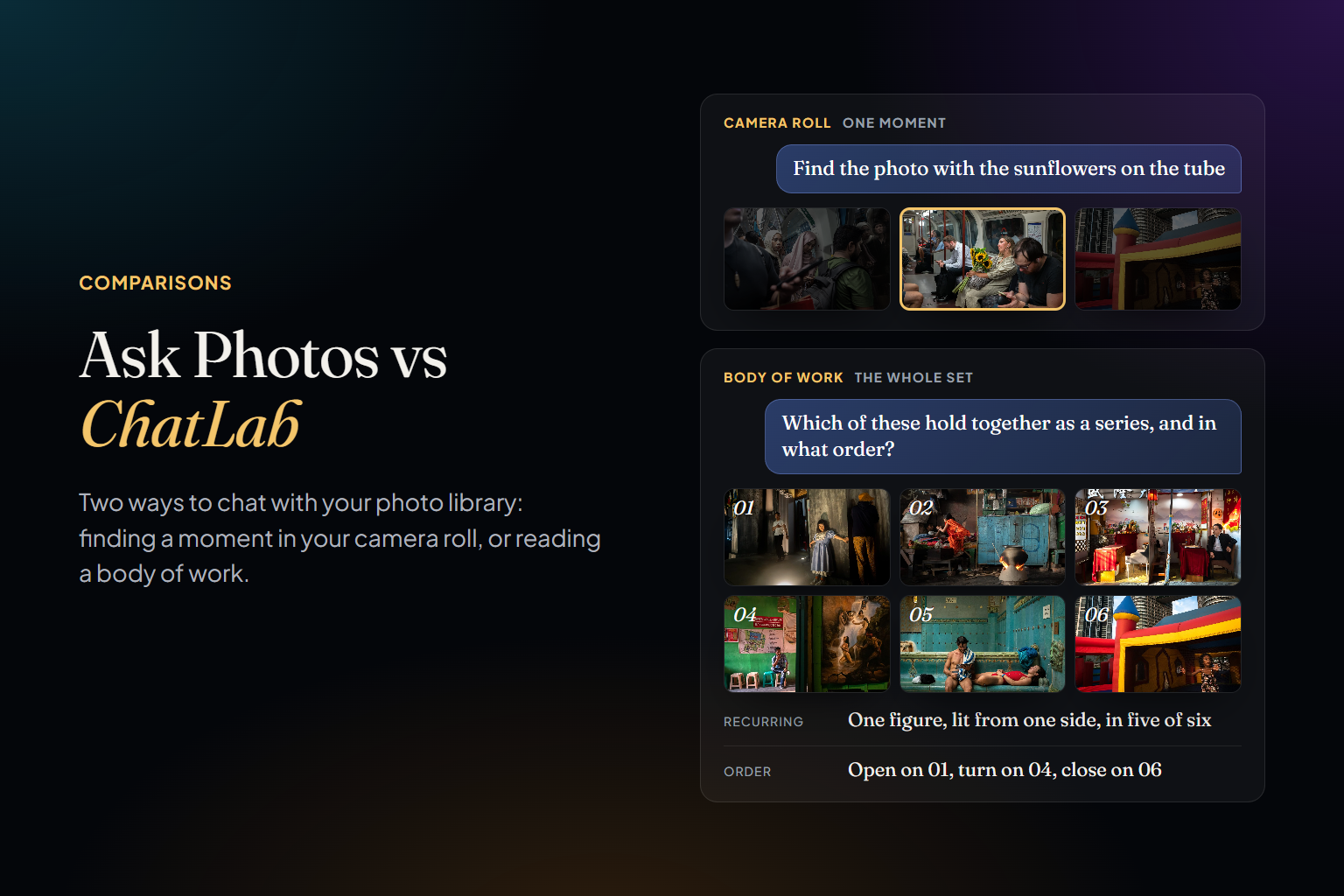
And you can simply ask. ChatLab answers questions such as “Which collection best represents my style?”, “How has my style changed since 2022?” or “What's my most common lighting?” with your own photos as evidence. On the storyboard canvas, an assistant that sees the board describes what holds a set of photos together — a useful first draft of the sentence from step 3.
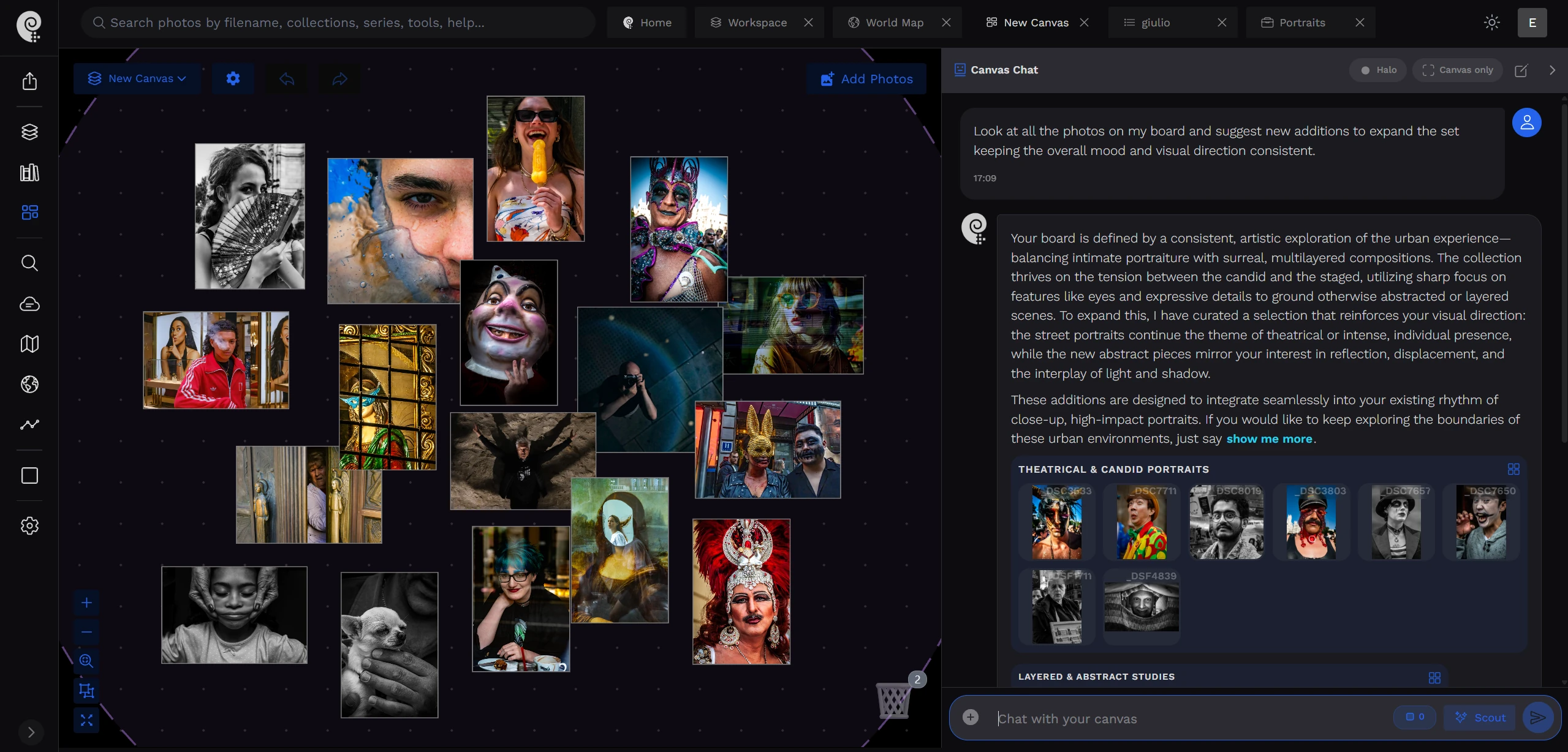
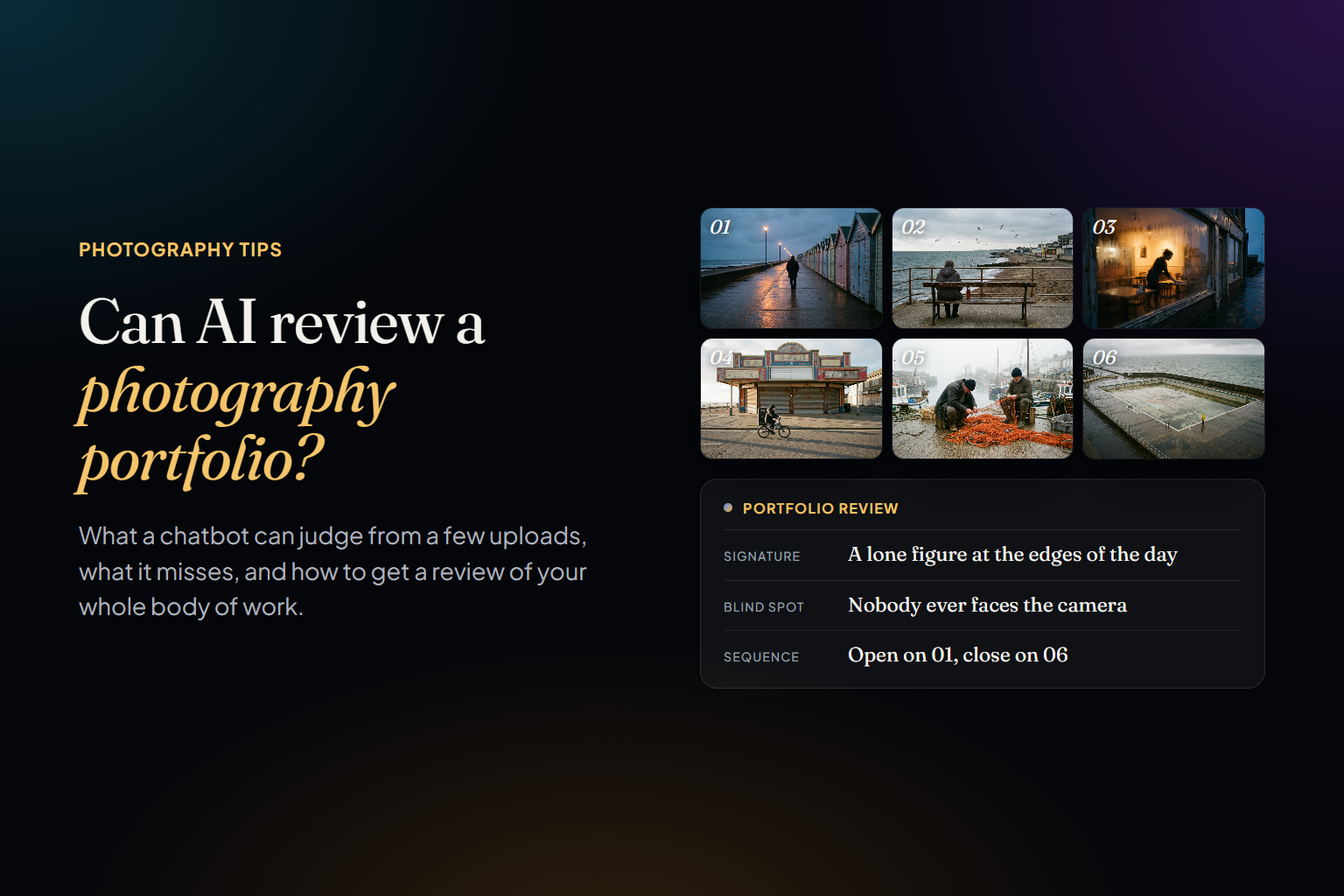
Treat it as the stranger from step 1, but one who has looked at every photo instead of twenty. The sentence that describes your style is still yours to write. It works best on a curated body of work: first insights appear from around a hundred photos, and patterns over time become meaningful with a few hundred spread across years.
See your style from the outside
Explore a real photographer's catalog
The demo includes the Atlas, a style report and ChatLab on a real, already-curated archive. Nothing to install.