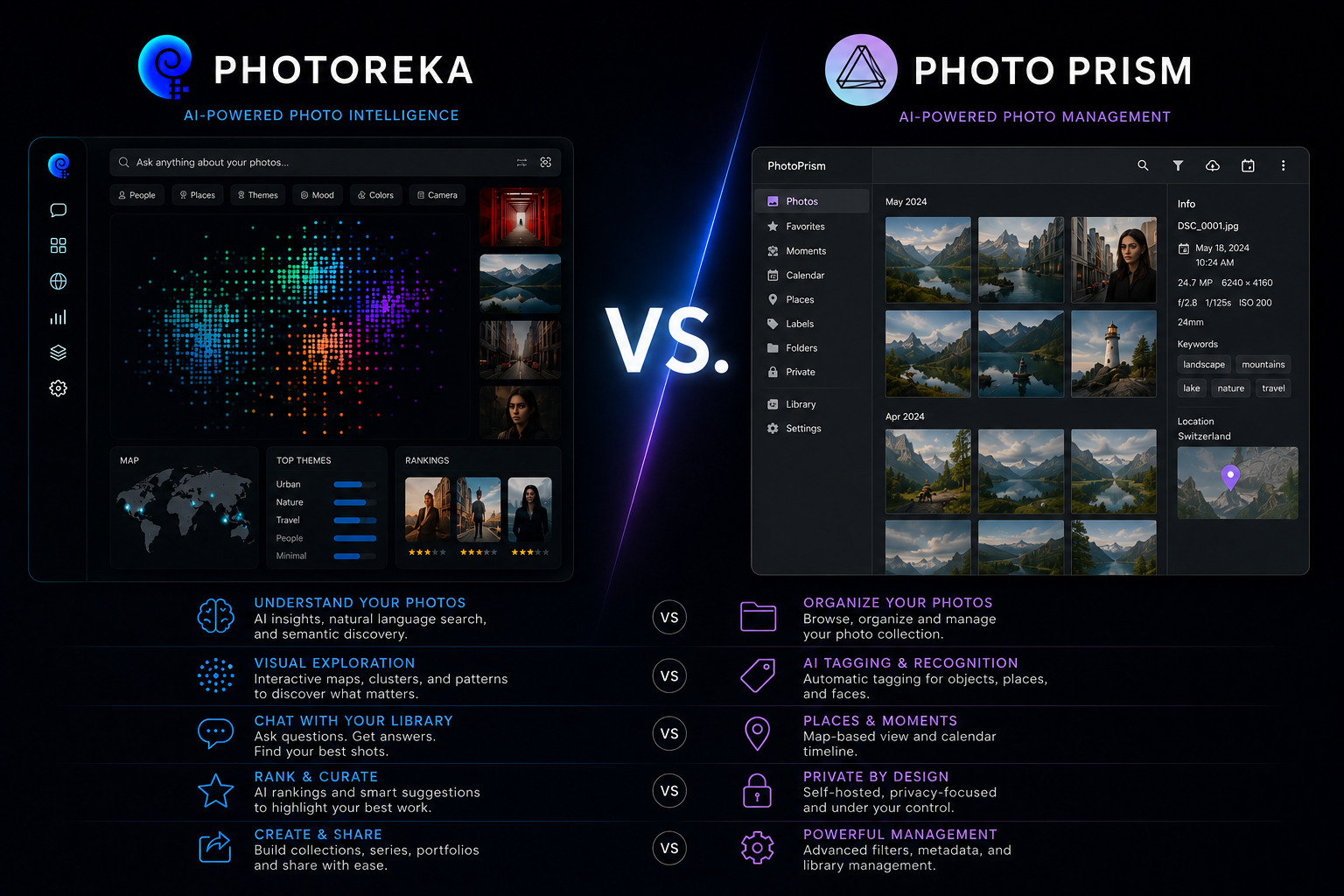
PhotoPrism deserves the praise it gets. It's open source, it runs on your own hardware, it has a genuinely good browser interface that works on every device you own, and it does real computer vision: TensorFlow classification for labels, an ONNX face detector feeding FaceNet embeddings clustered into people, places and maps from GPS data, and — more recently — caption generation through Ollama or OpenAI, so the AI layer can run entirely on your own machine if you want it to. For anyone who wants Google Photos without Google, it's one of the two or three serious answers.
So the comparison here isn't about which is better software. It's about a distinction that gets blurred constantly: PhotoPrism solves ownership. It doesn't solve judgment. Those are different problems, and knowing which one is actually hurting you decides whether the next thing you install is a server or something else entirely.
What PhotoPrism Does Well
An honest comparison starts here. PhotoPrism is the strongest expression of a good idea: your photo library should be a service you run, not a service you rent. The Community edition is free and AGPL-licensed. It indexes originals in place, generates thumbnails and sidecars, exposes everything through a fast web UI and WebDAV, handles video, supports multiple users so a whole household can share one library, and scales to whatever your disks can hold. Nothing is sent anywhere unless you deliberately point the vision layer at an external API. If your concern is that a company will change its pricing, its terms, or its mind about your family photos, PhotoPrism removes that company from the equation entirely.
If your problem is where my photos live and who controls them — you want a private, self-hosted library with faces, places, albums, video, and access from every device, and you're comfortable maintaining a Docker container — install PhotoPrism. It's very good at that, and nothing in this article suggests otherwise. The rest of this piece is about a problem it wasn't built for.
Where the Walls Are
PhotoPrism's architecture makes one central bet: turn pictures into words, then search the words. Labels, captions, keywords, EXIF fields, places, people — all of it becomes text in a database, and the search box queries that text. It's a sound design, and it has a ceiling.
- A caption is a lossy summary written before you knew the question. 'Two people walking on a beach' is accurate and useless when what you're actually looking for is the frame where the light went strange and the gesture landed. The photograph contains that. The sentence doesn't.
- Labels are a vocabulary, and vocabularies have edges. Classification models return classes they were trained on. Nothing in that list corresponds to 'tension', 'restraint', or 'the composition I keep accidentally repeating'.
- The quality score is a junk filter, not a judgment. PhotoPrism scores photos 1–5 and hides anything under 3 pending review — the goal being to keep screenshots, memes, and broken files out of your library. It even goes up when you add a location or hit like. It's explicitly not about whether the picture is any good.
- The unit is the memory, not the body of work. Moments, albums, people, trips. Excellent for a family archive; it has no concept of a portfolio, a sequence, or an artistic through-line.
- The price isn't money, it's operations. Docker, storage planning, indexing runs, upgrades, backups you actually test. That's a real, recurring cost paid in your time — and if the container is down, so is your library.
- It takes custody. PhotoPrism wants to be where the photos live: its volumes, its folder conventions, its sidecars, its database. That's the deal you sign for everything it gives you.
Photoreka's Different Starting Point
Photoreka isn't a place to put photos, and never asks to be. It's an intelligence layer that comes to the archive you already have.
1. It searches the image, not a description of the image. Every photo becomes an embedding — a numerical description of composition, light, palette, subject, and mood. There's no caption in between to lose the thing you were actually looking for.
2. Nothing to host, nothing to maintain. It runs in the browser on Windows, Mac, and Linux, and connects to Lightroom Classic (via an official plugin), Google Photos, Dropbox, and local files. Analysis happens in the cloud from compressed previews; your full-resolution originals stay exactly where they are. No container, no backup strategy, no 2am indexing job.
3. Curation is the destination, not a feature. Finding is step one. Photoreka is built for what comes after: scoring, choosing, ranking, and sequencing the work that matters.
PhotoPrism answers 'is my archive safe, private, and mine?'. That's a question about custody. It has never once told a photographer which forty pictures are the good ones.
Feature by Feature
Search
PhotoPrism's search is a well-built filter language over indexed text and metadata: labels, captions, titles, keywords, people, colors, cameras, countries, dates, with AND/NOT operators. It's precise and fast within its vocabulary. Photoreka's search works against the image itself, in three explicit modes: Broad (pure embedding similarity, for moods and styles), Adaptive (expands cultural references like 'Blade Runner-inspired' into their implicit visual vocabulary), and Precise (a logical inference layer that verifies each result against your conditions — 'exactly three people, one looking away' means exactly that). There's no query length limit, so a long, specific description isn't silently truncated.
The practical difference: in PhotoPrism, your query has to survive being matched against a caption someone's model wrote months ago. In Photoreka, the query meets the photograph.
Quality Scores vs. Artistic Scoring
PhotoPrism's 1–5 score exists to decide what deserves to be in your library. Photoreka's scoring exists to decide what deserves to be seen, and keeps the dimensions separate rather than collapsing them into one number: aesthetics, composition, narrative strength, originality, visual games, humor, candidness, plus subject clarity and commercial intent for commercial work. That separation is the point — the same catalog ranks differently for a gallery submission than for a stock pitch, and a single global score can't express that.
Beyond Organization
Here the two products stop overlapping entirely. Photoreka includes a portfolio builder that selects and sequences 10–40 images under coherence constraints (visual, chromatic, narrative), a conversational assistant that can critique your portfolio and track how your work evolves, style and pattern reports, and a 2D/3D atlas that renders your entire archive as a navigable space rather than an infinite scroll. PhotoPrism has no equivalent, and shouldn't be criticized for it — a library server's job ends where the editing decisions begin.
Where PhotoPrism Still Wins
Fairness requires this section. PhotoPrism is free and open source, with no per-analysis cost and no vendor at all. It can run fully offline, vision layer included, which is decisive if cloud analysis is a hard no. It handles video; Photoreka is photography-only. It does face recognition and people management, which Photoreka doesn't. It serves multiple users from one library, syncs over WebDAV, works as a PWA on your phone, and — crucially — it can actually be your storage. Photoreka can't replace any of that, because it isn't trying to.
Two Different Anxieties
Most photographers evaluating these tools are carrying one of two very different worries. The first is I don't trust anyone else with my archive — that's a custody problem, and PhotoPrism is a great answer to it. The second is I have forty thousand photographs and no idea which ones matter — that's a judgment problem, and no amount of self-hosting touches it. A perfectly private, perfectly backed-up, perfectly labeled library where you still can't tell which twenty frames are your best work is a solved storage problem sitting on top of an unsolved curation problem.
- Choose PhotoPrism if: you want a private self-hosted library you fully control, you need video, faces, maps, and multi-user access, and you're happy to run and maintain a server.
- Choose Photoreka if: hosting isn't the thing you want to spend time on, you'd rather search the image than a caption of it, and your real goal isn't storing the archive — it's curating it: scoring, selecting, sequencing, and understanding a body of work.
- Use both if: PhotoPrism is already the vault and what's missing isn't safety or access, but the ability to look at everything you've shot and say which of it is worth showing.
Try Photoreka's demo — no server required
Semantic search, artistic scores, and the 3D Atlas on a real catalog, straight from the browser.
One last note on philosophy. PhotoPrism's bet — that your photographs shouldn't be hostage to somebody else's business model — is one we take seriously, which is why Photoreka never moves your originals or asks to become their home. Where we differ is on what happens next. Owning your archive is necessary. It just isn't sufficient. Storage is the floor. Curation is the point.